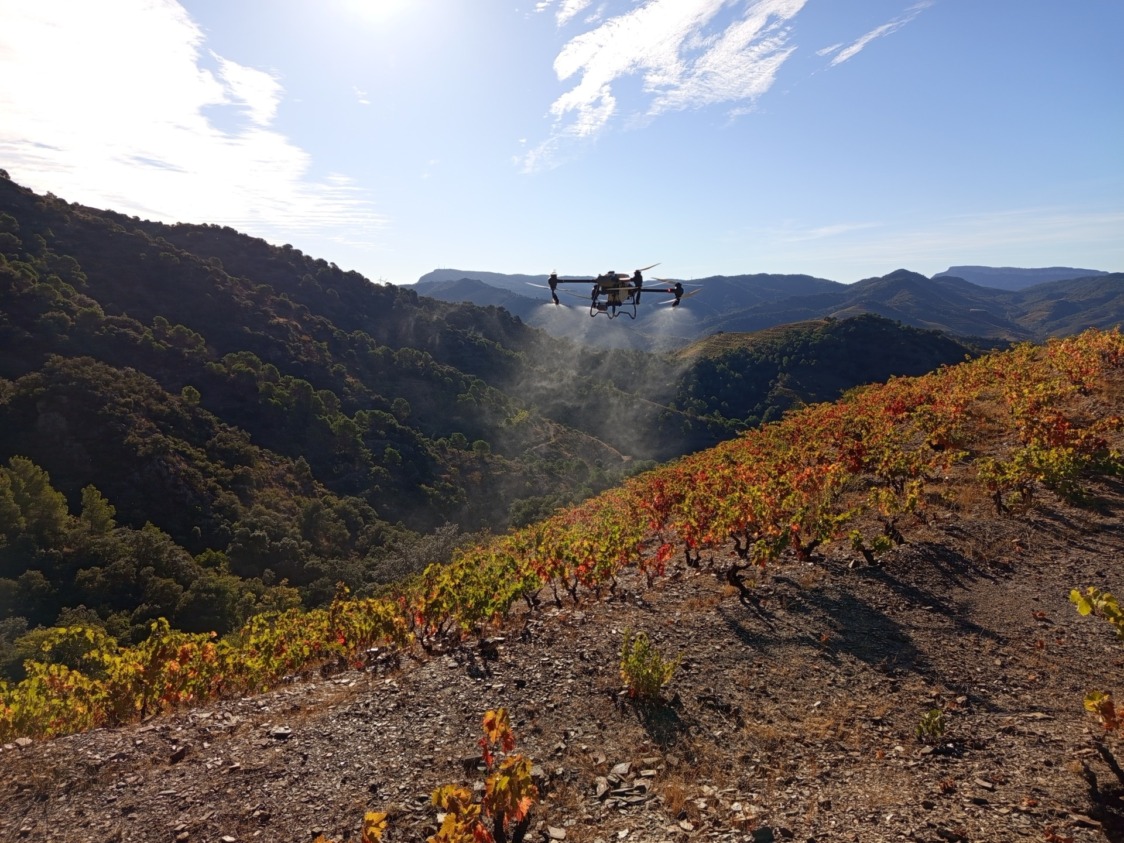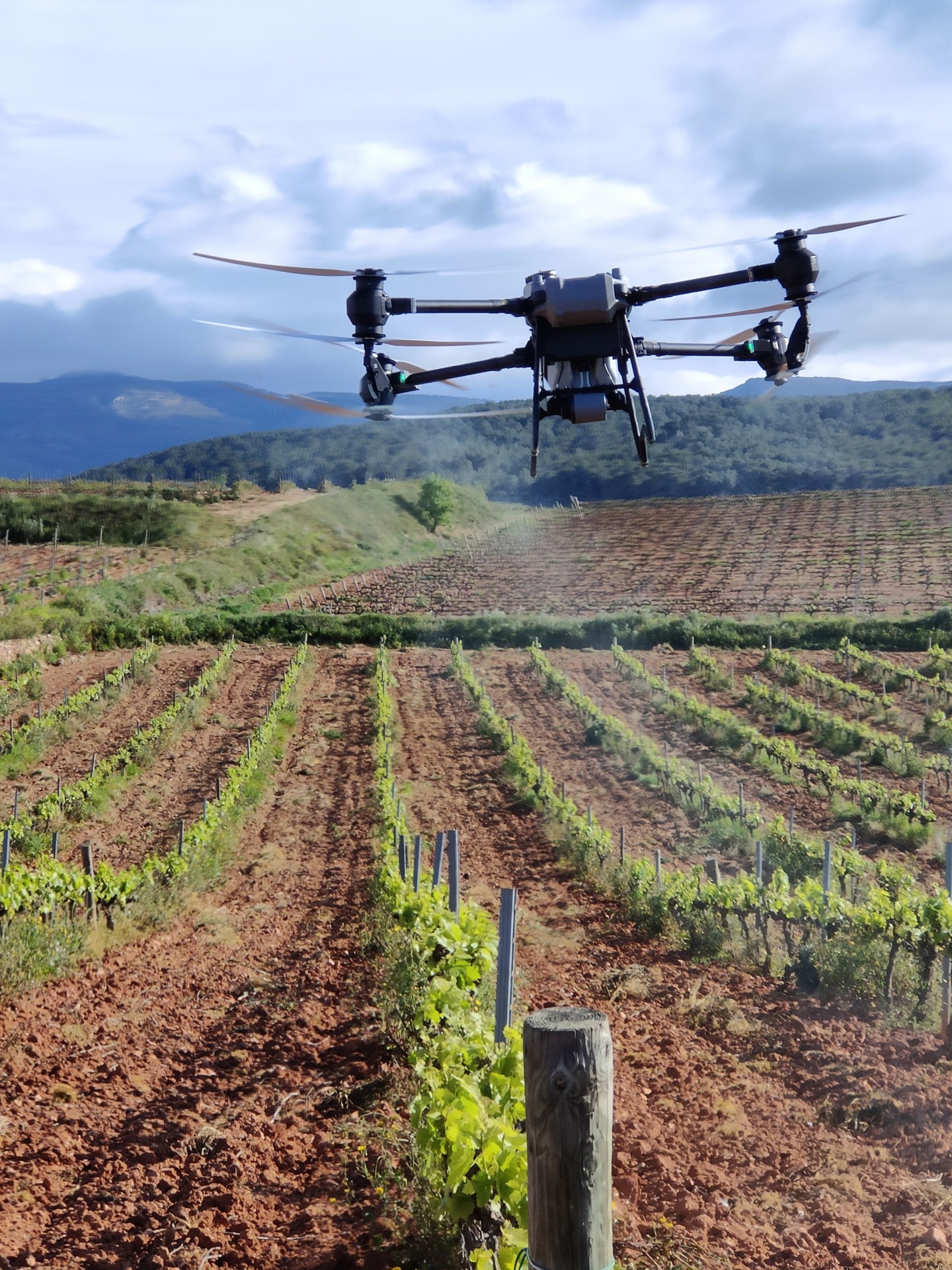
A project by Agrotecnio, the Catalan Wine Cluster, the wineries Familia Torres, Rendé-Masdéu, and the Vila-rodona Cooperative calls for regulations allowing their widespread use in Spain.
Drones could soon become a key tool for phytosanitary treatments in vineyards, especially in farms located in areas with steep slopes or complex terrain, where access with tractors or conventional equipment is difficult, costly, or even impossible. In addition to facilitating fieldwork, this technology significantly reduces workers’ exposure to phytosanitary products.
This is one of the main conclusions of the DRONVINYA project, in which Agrotecnio, the Catalan Wine Cluster, INNOVI, and the wineries Familia Torres, Rendé-Masdéu, and the Vila-rodona Cooperative participate. The study concludes that the use of drones is technically justified, especially in plots with difficult access or during periods of continuous rainfall that prevent the entry of ground machinery.
The results show that the most favourable contexts for this technology are vineyards with low vegetative vigour, trained in goblet (bush vine) form, and applications carried out in the early stages of vegetative development, preferably until early June.
The researchers also warn that drone applications require very specific conditions to ensure their effectiveness and safety. Spraying must be carried out under calm atmospheric conditions and in strict compliance with safety buffer zones, as the centrifugal spraying systems used by drones are particularly sensitive to wind.
The trials were conducted between 2024 and 2026 in five plots located in Priorat, Anoia and Alt Camp, featuring different types of terrain, training systems and varietal sensitivity. For the treatments, a DJI AGRAS T50 drone equipped with four centrifugal nozzles was used, applying sulphur-based formulations for the control of grapevine powdery mildew.
They call for regulation that allows their use
Despite technological advances and the experience accumulated in other European countries, the use of drones for phytosanitary treatments is still not generally authorised in Spain, where restrictions associated with aerial applications remain in place.
In contrast, countries such as Germany, France and Switzerland already have regulatory frameworks that allow this type of application under strict conditions, especially in vineyards located on steep slopes.
According to the project leaders, the new European legislative proposals point towards a relaxation of regulations, with the aim of recognising drones as a precision technology capable of reducing occupational risks and environmental impacts.
For this reason, the project urges the competent authorities to move forward with regulating their use. The report concludes that there are no technical barriers preventing the Spanish Ministry of Agriculture, Fisheries and Food and the Catalan Department of Agriculture from authorising these applications under criteria similar to those already applied in other European countries.
The proposal sets out a regulatory framework based on prior assessment of drone models, specific weather limitations, and strict safety protocols and buffer distances.
The DRONVINYA project has been led by the Familia Torres wineries. The Catalan Wine Cluster, INNOVI, has coordinated its development, while the Crop Protection Research Group at Agrotecnio has taken on the technical and scientific leadership. It is a project funded by the Government of Catalonia, and it forms part of the Operational Group projects of the European Innovation Partnership for Agricultural Productivity and Sustainability (EIP-Agri), within the framework of the 2023–2027 CAP Strategic Plan.