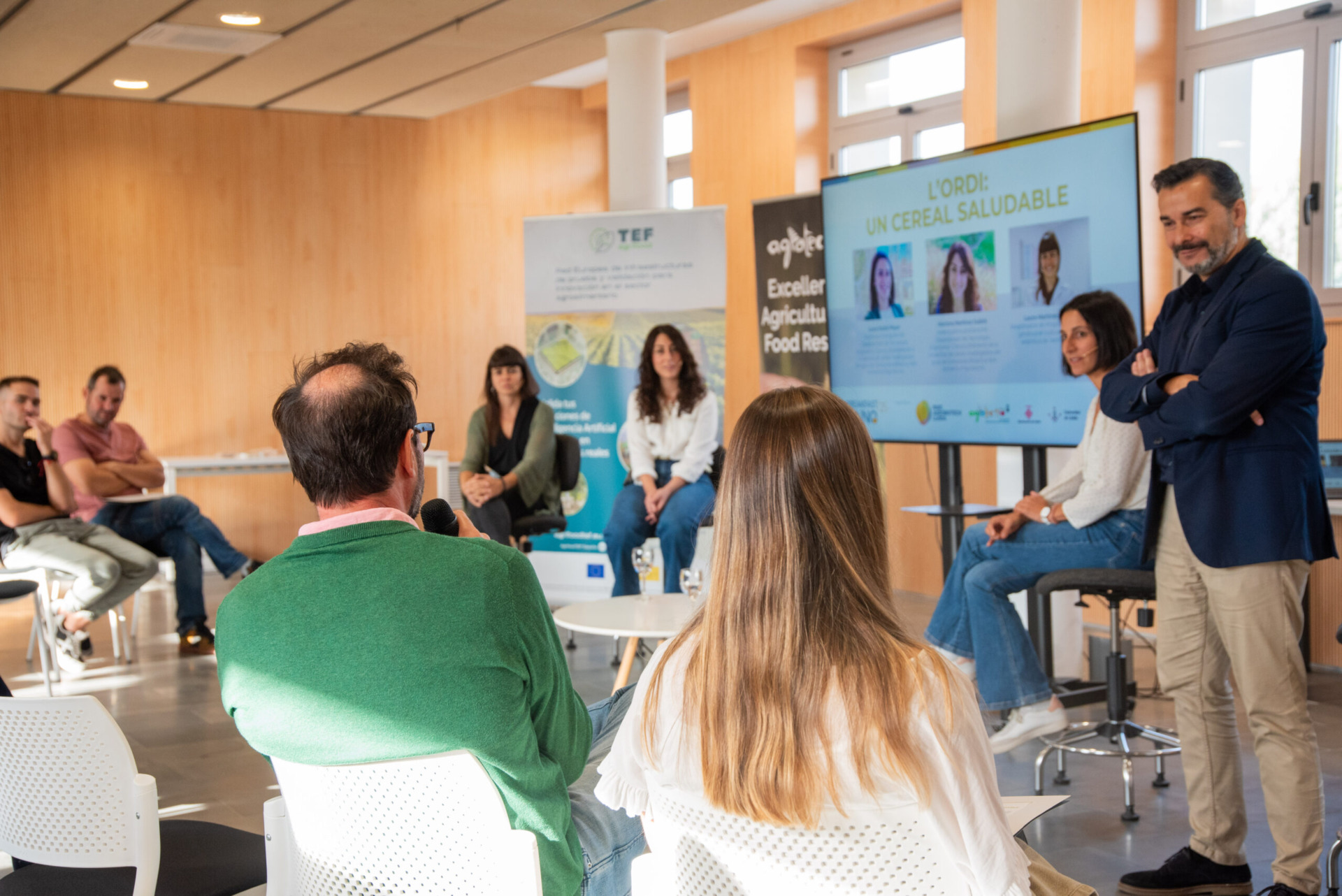
- Agrotecnio, the University of Lleida, and Semillas Batlle present their research on barley enriched with β-glucans and polyphenols at Breakfast4Inno
- The speakers highlight the potential of biofortified barley and urge the industry to invest in its commercial valorization
Barley and its potential to improve health were the focus of the latest Breakfast4Inno innovation breakfast, held at the Parc Agrobiotech in Lleida. The company Semillas Batlle (Bell-lloc) and the Bioactive Food Compounds group from Agrotecnio and the University of Lleida (UdL) presented their advances in developing new barley varieties with health-promoting properties.
The research led by Laura Rubió, an Agrotecnio researcher and UdL professor, shows the great nutritional potential of biofortified barleys, characterized by a high concentration of bioactive compounds such as β-glucans, a type of soluble fiber, and polyphenols.
The barley breeding work has been carried out in collaboration with international universities in Scotland and Oregon and with the company Semillas Batlle, which has already registered three pioneering barley varieties for human consumption: Annapurna, Kamalamai, and Rajapani.
According to Laura Martínez Planton, head of barley breeding at Semillas Batlle, “In addition to being enriched, these varieties show excellent adaptation to the Mediterranean climate, with high cold resistance and greater ease of industrial processing.” She also revealed that new advanced purple-colored lines are currently being developed, with high polyphenol content and an added appeal for consumers.
Regarding health studies, trials conducted in vitro, in animals, and in humans demonstrate that consumption of these barley varieties can help reduce cholesterol, positively modulate the gut microbiota, regulate blood glucose, and prevent metabolic diseases such as type II diabetes.
These findings open the door to the development of new functional foods based on biofortified barley, a cereal that fits perfectly within the Mediterranean diet pattern due to its richness in fiber, bioactive compounds, and its ability to contribute to healthy and sustainable nutrition. As UdL researcher Mariona Martínez highlighted, these varieties can be easily incorporated into everyday products such as bread, pasta, cookies, plant-based burgers, or even teas and kombuchas. The three speakers all called on the food industry to invest in this cereal. “The scientific evidence is already clear: barley is a cereal with health benefits. The challenge now is to transform this knowledge into products that reach the consumer’s table,” they emphasized.
Although traditionally barley has been used for animal feed or beer production, its consumption by humans dates back to the Neolithic and remains common in many Asian cultures.
Barley as a tool for colorectal cancer prevention
Currently, Agrotecnio and UdL are working on various projects aimed at developing high-value barley-based products. Within the framework of the BARGUT project, funded by Agrotecnio and now in its final phase, it has been shown that a significant portion of the bioactive compounds in barley—both fiber and polyphenols—reach the colon intact, where they are fermented by the microbiota, generating butyric acid and other metabolites with prebiotic effects.
At present, the CHEMBAR project from the
Agrohealth call, led by Laura Rubió and Diego Arango del Corro from IRBLleida, is investigating the potential of barley in colorectal cancer prevention. The project adopts an interdisciplinary approach that combines in vitro digestion models, animal models, and the use of intestinal organoids, an innovative three-dimensional cellular model that reproduces the structure and function of human colon tissue. Through these models, researchers will evaluate how biofortified barley can interact with tumor cells and help prevent the progression of colorectal cancer, one of the most prevalent diseases closely linked to dietary habits.