Postharvest Biology & Technology
Objectives
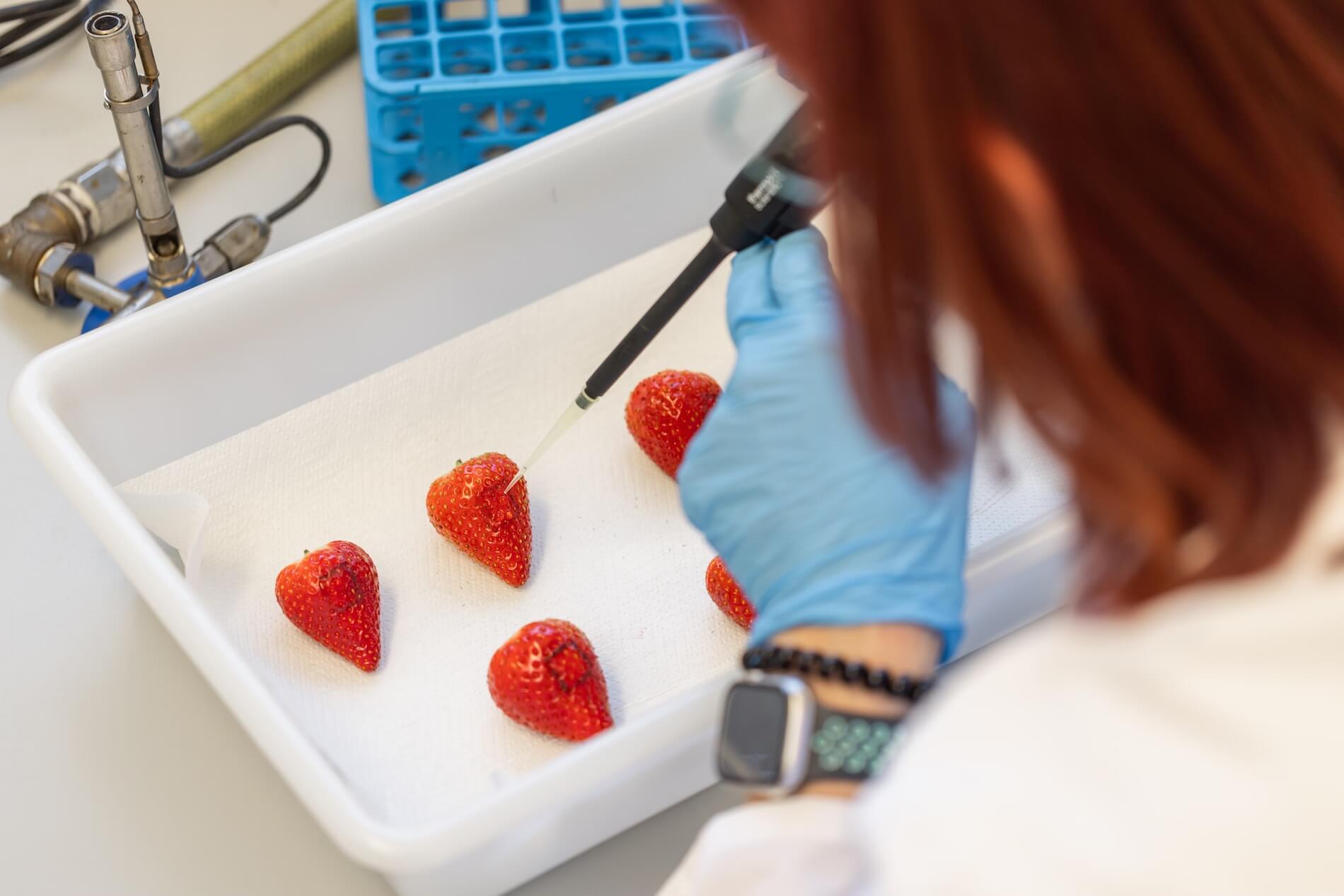
The overall objective of Agrotecnio’s Postharvest Biology & Technology group is to improve the quality and safety of plant products and their derivatives throughout the food chain.
The group’s research focuses on identifying and controlling microbiological hazards and spoilage microorganisms present in fresh and processed fruit and vegetables, with the aim of developing new strategies for their reduction and control, thereby guaranteeing food safety and quality.
At the same time, the group investigates the physiological compounds and processes that determine the main quality characteristics of fruit, both during ripening and in the post-harvest phase, with special attention to the biochemical processes responsible for changes in flavour and texture. In addition, volatile compounds naturally present in fruit and vegetables are used to develop strategies based on biomarkers of alterations or diseases, with the aim of optimising organoleptic quality and ensuring food safety.
Research lines
- Characterisation of microbiological hazards and spoilage microorganisms in fresh, minimally processed and processed fruit and vegetables.
- Development of biopreservation strategies and physical and chemical treatments for the control of foodborne pathogens and spoilage microorganisms in fresh, minimally processed and processed fruit and vegetables.
- Application of molecular tools to understand the mechanisms of spoilage or pathogenicity of microorganisms in fruit and vegetables.
- Study of the physiological and biochemical bases of fruit quality.
- Improvement and quality control in pre- and post-harvest fruit and vegetables, with special emphasis on aroma and organoleptic quality.
- Detection, isolation and use of volatile compounds present in fruit as biomarkers of alterations and diseases.
- Isolation, characterisation and application of volatile compounds from food industry by-products as flavourings in plant-based foods.
Main activities
- Study of the incidence and survival of foodborne pathogens in fresh and processed fruit and vegetables using microbiological and molecular tools.
- Evaluation and validation of new or alternative methods to reduce and control the growth of spoilage microorganisms and foodborne pathogens.
- Study and validation of biological control agents under laboratory and pilot plant conditions.
- Study of the mechanisms of metabolite production by spoilage microorganisms.
- Analysis of the interaction between microorganisms and fruit and vegetables.
- Study of the role of the fruit cuticle in modulating post-harvest quality, commercial life and storage potential, and responses to environmental conditions and biotic and abiotic stress factors.
International impact
The research carried out by the Post-Harvest Biology and Technology group has a well-established international presence, reflected in collaborations with prestigious centres and universities, which have led to publications in JCR-indexed journals, as well as student and research staff exchanges. The group also welcomes international researchers and students.
Among the most notable collaborations are institutions in Germany (Würzburg Universität), Portugal (Universidade de Lisboa and Universidade de Aveiro), Chile (Universidad de Talca), New Zealand (Plant and Food Research Ltd.), Ireland (Teagasc), and the Netherlands (Wageningen University and Research). Also noteworthy is the transfer of knowledge to the agri-food sector through collaborations with companies from Germany and the United States of America.