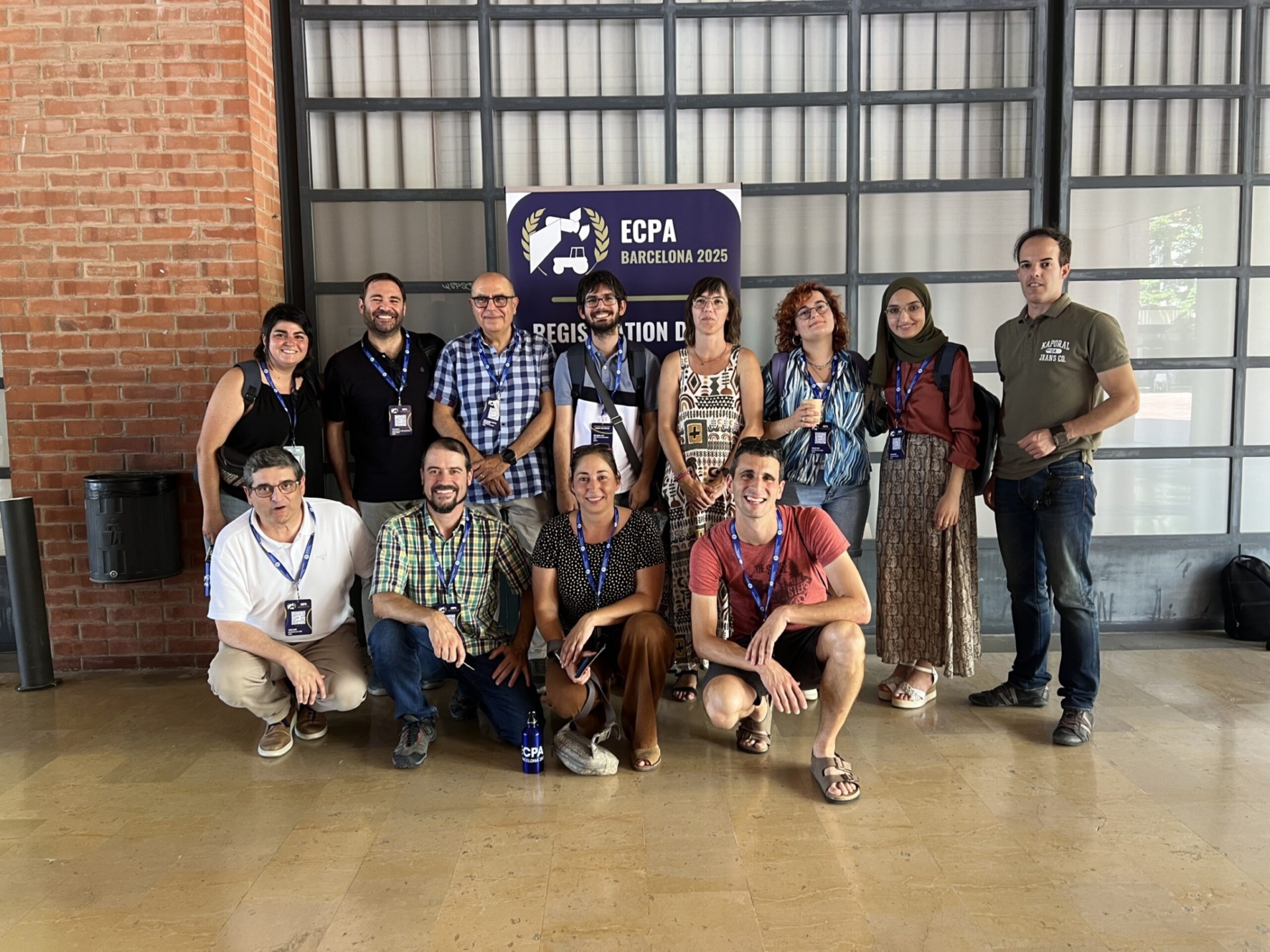
- The AgroICT and Precision Agriculture research group from the University of Lleida and Agrotecnio presents six high-level contributions at ECPA 2025
The AgroICT and Precision Agriculture Research Group (GRAP) of the University of Lleida and Agrotecnio has demonstrated its leadership in digital agriculture during the 15th European Conference on Precision Agriculture (ECPA 2025), held in Barcelona from June 29 to July 3. With six high-level contributions, GRAP has shown how advanced sensor technologies, spatial analysis, and data-driven decision-making are transforming the sustainable management of crops.
Smart pest monitoring and new variables for variable rate applications
The researchers presented a pioneering study on the spatiotemporal dynamics of the codling moth (
Cydia pomonella) in apple orchards. Through the installation of georeferenced traps and geostatistical maps, they demonstrated that this pest shows a highly structured and localized distribution in space and time. The
study highlights that the trap location significantly influences pest detection and the optimal timing for intervention, paving the way for integrating pest maps into Integrated Pest Management (IPM) strategies to improve the precision and effectiveness of interventions.
In a second
study focused on the same pest, the team explored the relationship between canopy structure and pest incidence using parameters derived from LiDAR technology. By combining pest capture data with information on foliage porosity and cross-sectional area, logistic regression models were developed to predict infestation hotspots. This innovative methodology enables the generation of prescription maps for variable-rate applications of plant protection products, optimizing both efficiency and sustainability.
The Leafiness-LiDAR Index: measuring drought impact in apple orchards
Another noteworthy contribution was the application of the Leafiness-LiDAR Index (LLI) to assess the effects of water stress in apple orchards. Under both full irrigation and water deficit conditions, the study demonstrated a strong correlation between LLI, Leaf Area Index (LAI), and various production parameters. LLI proved to be more sensitive than traditional methods in detecting canopy changes associated with water scarcity, becoming an effective tool for managing the productivity and resilience of Mediterranean crops (
full article).
Low-cost 3D sensors for fruit tree monitoring
GRAP also evaluated the performance of affordable LiDAR sensors and RGB-D cameras for the 3D reconstruction of fruit trees. The
study showed that low-cost solid-state LiDAR sensors can achieve an accuracy of 10 to 12 mm, while RGB-D cameras with time-of-flight technology can reach up to 7 mm, even under low light conditions. These results open new possibilities for implementing affordable monitoring systems, bringing precision agriculture closer to farmers and service companies.
NDVI as an alternative to LiDAR in large-scale almond orchards
The researchers validated the use of the NDVI (Normalized Difference Vegetation Index), obtained via satellite, as an alternative for characterizing the canopy in super-intensive almond orchards. Strong correlations were found between NDVI and the canopy cross-sectional area obtained with LiDAR across different phenological stages. This
approach allows for remote, scalable, and effective monitoring of crop structure, facilitating variable-rate applications of water, fertilizers, and plant protection products.
Evaluation of fIPAR and its application in precision irrigation
Finally, joint
research between GRAP and IRTA focused on the fraction of photosynthetically active radiation intercepted (fIPAR) as an indicator to optimize precision irrigation. The effect of anti-hail nets on canopy reflectance and light transmission, which can distort remote sensing data, was also analyzed. The next steps include integrating radiative transfer models (RTM) with LiDAR data to improve fIPAR estimation and irrigation efficiency.
Commitment to data-driven and sustainable agriculture
The works presented by GRAP at ECPA 2025 are mainly framed within the
PAgPROTECT and
DIGIFRUIT projects, as well as the funding received from the European Social Fund (ESF), the REACT-EU fund, and the Ministry of Science and Innovation.
This set of contributions consolidates GRAP’s commitment to advancing precision agriculture through innovation, sustainability, and practical solutions for the agricultural sector. In the context of growing challenges such as climate change, resource scarcity, and environmental demands, GRAP’s research offers a clear roadmap toward a more efficient, technological, and resilient agriculture.