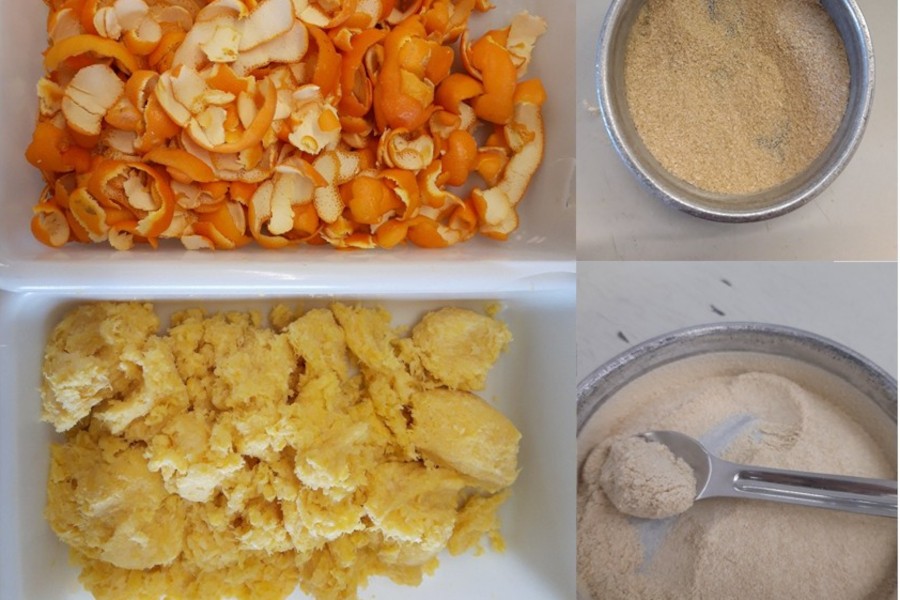
- Research to transform waste into high value-added ingredients for other foods like yogurts or juices
Lleida, May 26, 2025. Obtaining prebiotics that improve gut flora from apple and orange waste from the juice industry is the goal of a joint research project by the University of Lleida (UdL) – Agrotecnio and the Swiss multinational Société des Produits Nestlé. The research team has tested the potential of three techniques – high-pressure homogenization, enzymatic hydrolysis, and ultrasound – to obtain from pectin the highest concentration of oligosaccharides, sugars that feed the beneficial bacteria in the intestine; and from cellulose, another allergen-free sugar called cellobiose. These by-products, once processed, could be added to a wide range of products such as juices, yogurts, bread or sauces, among others. The first results have been published in the journals
Food Chemistry i
LWT Food Science and Technology.
The fundamental aim of these studies is to use biotechnology (enzymes) and advanced physical processing technologies (high-pressure homogenization and ultrasound) to turn fruit transformation waste into “food ingredients of high added value with improved prebiotic, techno-functional (such as water or oil retention), and antioxidant properties,” explains Pedro Elez, Professor of Food Technology and researcher at the Research Group on Innovative Technologies for the Production of Food Ingredients and Products of the UdL and the New Food Processing Technologies group at Agrotecnio. “It could be a more natural alternative to artificial or chemically synthesized additives in food formulation. In addition, these technologies can help boost and develop the circular bioeconomy,” he adds.
The team worked with bagasse (pressing residues) from apple and orange, as well as with orange peel. The results show that these residues have a “high potential to add health benefits to a food product due to their high content of dietary fiber and bioactive compounds.” Hydrolysis with cellulase and pectinase enzymes to break the chemical bonds of fruit by-products has proven to be an efficient tool to extract new prebiotic oligosaccharides. And in the case of orange peel, the amount increases if it is first subjected to high-pressure homogenization.
The studies also showed that prior ultrasound treatment improves the solubilization of pectin oligosaccharides and increases the total phenolic content (with antioxidant properties) in orange bagasse, while also improving bile acid adsorption capacity. Enzymatic hydrolysis has shown high efficiency in increasing the proportions of soluble dietary fiber in apple and orange residues through the release of prebiotic compounds. “It is an efficient tool to modulate their structural characteristics, that is, greater solubility and oligosaccharide concentration, and thus enable their use,” Elez emphasizes.
The conclusions indicate that hydrolyzed apple bagasse and orange peel processed with these technologies “show high potential to add health benefits to a food product due to their high content of dietary fiber and bioactive compounds, as they could promote the diversity and dynamic composition of the microbiota.” Likewise, the increase in oligosaccharide content and the improved bile acid adsorption capacity “could imply a potential prebiotic and cholesterol-lowering effect in enzymatically treated ingredients, something that deserves further research,” the studies report.
Text: Premsa UdL
MORE INFORMATION:
Article Prebiotic potential of pectin and cello-oligosaccharides from apple bagasse and orange peel produced by high-pressure homogenization and enzymatic hydrolysis
Article Ultrasonication and enzymatic treatment of apple and orange bagasses: Molecular characterization of released oligosaccharides and modification of techno-functional and health-related properties