- Dedicated to legal research applied to the sector, with special attention to European regulations, sustainability, food safety, consumer protection and environmental law.
- Agrotecnio and the Department of Law of the University of Lleida promote six interdisciplinary projects that combine legal and agronomic knowledge.
Agrotecnio has incorporated a new research area with the launch of a new research axis in Agri-Food Law, a cross-cutting line that aims to respond to the regulatory and social challenges of the agri-food sector. The initiative focuses especially on the study of European regulations, sustainability, food safety, consumer protection and environmental law, with the goal of contributing to more responsible governance and to safe, fair and sustainable food.
The new group arises from the collaboration between Agrotecnio and the Departments of Law of the University of Lleida (UdL). Both entities have recently launched six interdisciplinary projects that combine legal, economic and agronomic knowledge, opening new fields of research application and fostering the transfer of knowledge towards the productive sector and institutions.
The director of Agrotecnio, José Antonio Bonet, highlights that the creation of this new axis “is a unique initiative that will make it possible to generate an interdisciplinary research body in the agri-food field, a strategic area for Agrotecnio, the University of Lleida and for the territory.” For his part, the director of the Department of Law, César Cierco, emphasizes that the initiative is especially relevant “considering that a large part of the litigation taking place in Lleida is related to agri-food issues.”
A follow-up day of the joint projects
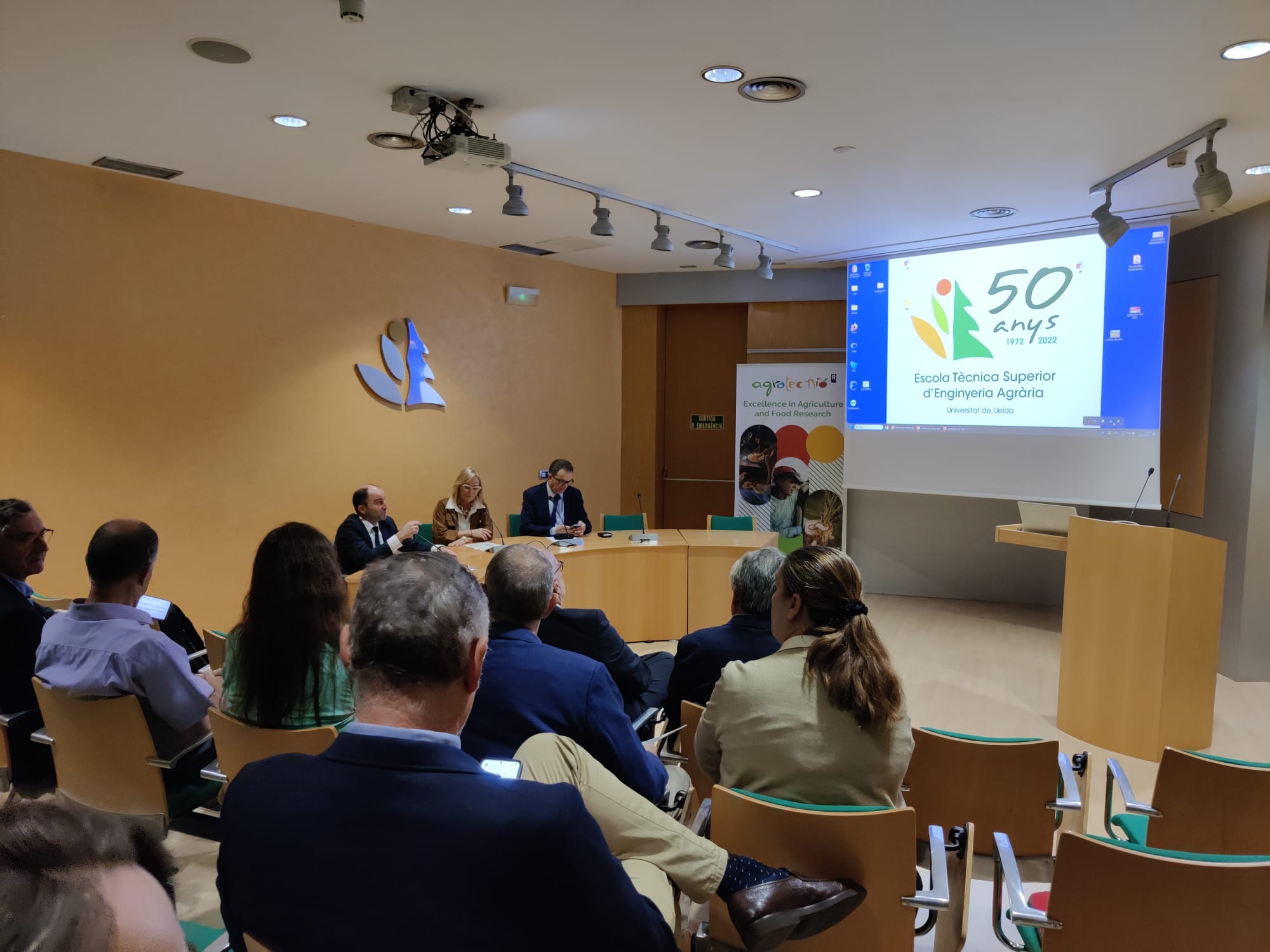
This week, a follow-up day of the six projects jointly promoted by Agrotecnio and the UdL was held on the ETSEAFiV campus. The event was presided over by the director of the Territorial Services of Justice and Democratic Quality in Lleida, Anna Miranda Torres, who highlighted “the added value provided by collaborative spaces such as this one, where a research center, the university, the administration and the private sector come together to promote and preserve an essential agricultural sector.”
The day began with a lecture by the magistrate of the Commercial Court of Lleida, Eduardo Enrech, who addressed the current legal framework of intellectual property of researchers in the field of plant varieties. Next, the six interdisciplinary projects were briefly presented:
“Legal implications of the non-compliance by EU Member States with the European Parliament resolution on genetically edited crops,” led by Antoni Vaquer, Paul Christou, Teresa Capell and Lourdes Salomón (from Agrotecnio and UdL). The project addresses the new CRISPR genome editing techniques developed by Emmanuelle Charpentier and Jennifer Doudna (Nobel Prize in Chemistry 2020), which allow the acceleration of crop genetic improvement by up to fifteen years. It analyses the EU proposal to exclude certain genetically edited crops from the GMO category and explores the legal avenues available to farmers and companies to claim an equitable application of the regulations among Member States.
“OliSost: Sustainability parameters in the value chain of extra virgin olive oil and strategies to ensure its communication,” by Eimys Ortiz, Adela Pagès and Rosa M. Florensa (Agrotecnio and UdL). The study analyses the regulatory framework of the olive oil sector, with special attention to the PDO Les Garrigues, the first region to obtain this designation in 1996. The project seeks to establish parameters to maintain the sustainability of crops and to propose communication strategies for cooperatives and companies in the area.
“Truffle cultivation: agricultural or forestry crop?” by César Cierco, José Antonio Bonet, Eduard-Valentín Pavel (Agrotecnio and UdL) and Daniel Oliach (CTFC-UdL). As Cierco explained, there is a situation of legal uncertainty because it is not clearly defined whether truffle cultivation should be considered an agricultural or forestry crop. This lack of definition generates difficulties in the regulation and management of the farms. The Valencian Community is, for now, the only one that has established specific regulation, while Italy has clearer and more effective legislation.
The study “Level of Internet use and e-commerce by pig farms,” carried out by Luis Miguel Pla, Eduard Cristóbal-Fransi, Pol Llagostera and Margarita Moltó (UdL), analyses 445 websites of Spanish pig farms to determine their level of digital maturity. The results show that although most companies have an online presence, their digital activity is focused on the dissemination of basic information, with a low level of interactivity and limited adoption of e-commerce (less than 16%). Microenterprises show a slight advantage in technological innovation, while information security is a widespread strength. The study recommends improving digital communication, incorporating interactive tools and promoting online sales, since a good web presence positively influences the image and competitiveness of the pig sector.
“Impact of antibiotic reduction policies on the health and welfare of dairy cows,” by Irina García and Laura Salamero (UdL). The project starts from the problem of antimicrobial resistance (AMR), regulated since the 1960s, and analyses the impact of restrictions on antibiotic use on animal welfare. The researchers have designed a survey addressed to veterinary professionals, distributed through associations and personal contacts.
“The role of women in the conservation of agrobiodiversity in Tolima (Colombia),” by Déborah Presta (UdL) and Joel Segarra (Universitat de Barcelona – Agrotecnio). The project studies the role of women in the management and conservation of agricultural biodiversity in four areas of the department of Tolima (Colombia), a region with great climatic and topographic diversity. The study analyses how female participation in farm management influences crop diversity and sustainable practices, and is carried out in collaboration with the University of Ibagué and Uniminuto of Bogotá.
These projects have the collaboration and funding of the Department of Agriculture, Livestock, Fisheries and Food.