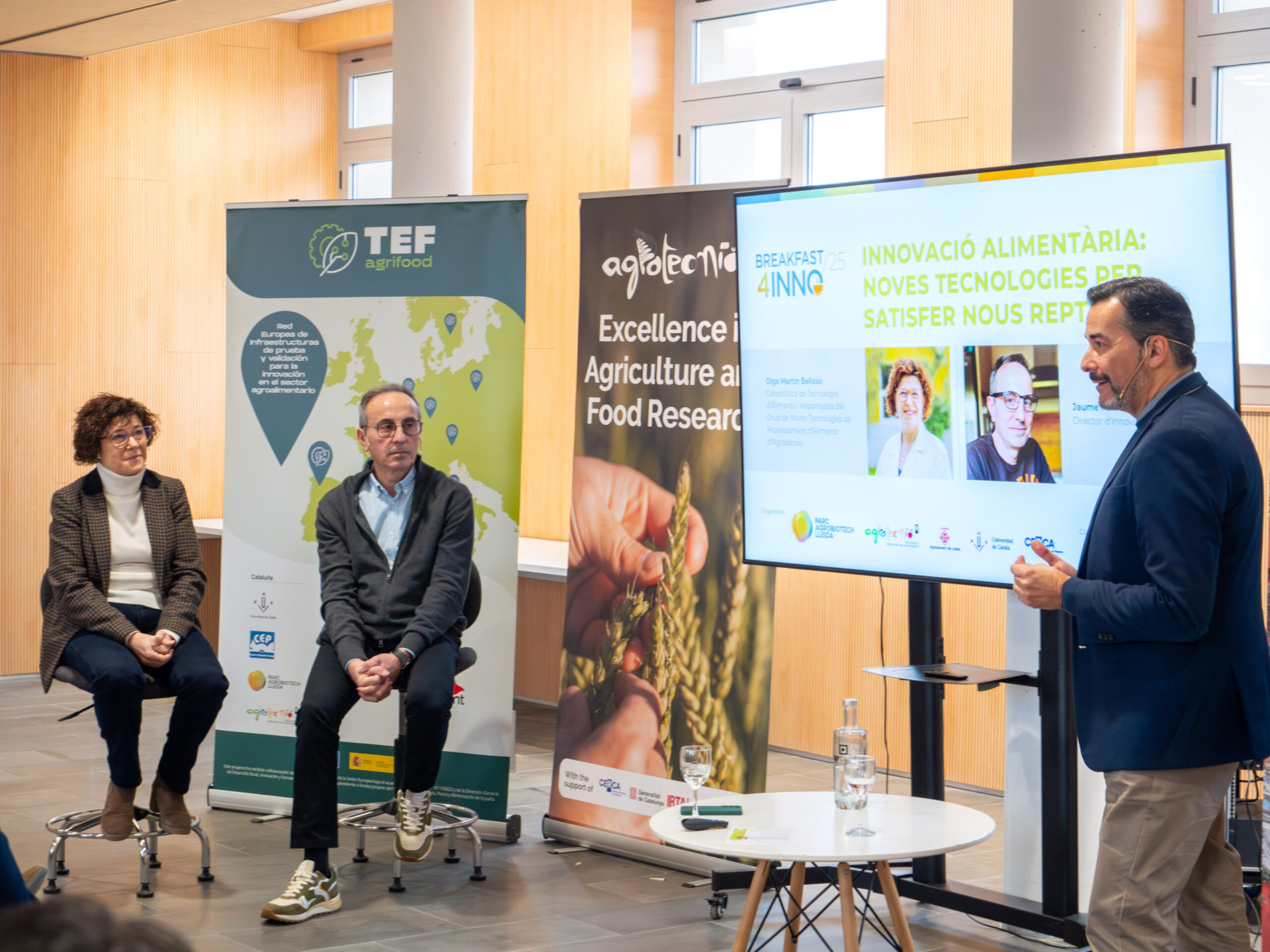
The University, the research center, and the agri-food company present several joint projects to advance healthier, more sustainable, and innovative foods
The New Food Processing Technologies Group of Agrotecnio–University of Lleida (UdL) and the company Argal have collaborated for decades on projects aimed at reducing additives, incorporating high-value functional plant-based ingredients, and improving food preservation. Today, in a new edition of Breakfast4Inno—the innovation meetings organized by Agrotecnio and the Agrobiotech Park of Lleida—some of these developments have been presented, contributing to healthier and more sustainable food.
The Professor of Food Technology at UdL and head of the group, Olga Martín-Belloso, showcased her team’s work on advanced processing technologies, such as pulsed electric fields (PEF), ultrasounds, pulsed light, 3D printing, and nanoengineering.
PEF allows continuous pasteurization of foods, improves the extraction of juices and oils, and stimulates the generation of bioactive compounds. Additionally, PEF can be used to obtain functional ingredients, such as dietary fiber or antioxidant extracts, from fruit and vegetable by-products, as well as to modify macromolecules like starch to enhance their technological functionality.
At the same time, edible coatings developed by the group help extend the shelf life of fresh and minimally processed foods by reducing transpiration, preserving aromas, and minimizing liquid loss, among other functions. The team also researches the use of nanoemulsions to extend food shelf life or to incorporate vitamins and antioxidants, as well as plant-based hydrogels and oleogels to reduce or replace saturated fats in processed foods.
According to Martín-Belloso, “these technologies allow us to advance toward a more sustainable food industry, with higher-quality products and more efficient processes. Public-private collaboration accelerates the transfer of knowledge into high-value industrial solutions for both the sector and the consumer.”
Among the group’s recent developments are plant-based creams enriched with bioactive compounds derived from horticultural by-products, edible coatings that extend the shelf life of fresh products, and systems of nanoemulsions, hydrogels, and plant-based oleogels designed to reduce saturated fat content and provide beneficial compounds with improved absorption in the human body.
Three Strategic Projects with Argal
The collaboration between the University of Lleida (UdL) and Argal, which began in 1995, has generated patents and consolidated a long-standing technological partnership. Argal’s Director of Innovation, Jaume Palau Clivillé, outlined three key projects developed jointly with the Agrotecnio-UdL research group:
NITRATES: Reduction of nitrates and improvement of microbiological safety.
The project has enabled the creation of formulations with fewer, or no, nitrifying salts in cured meat products while maintaining food safety and organoleptic quality. The nitrite-free fuet will be marketed in France in 2026.
VEGECREM: High-end functional plant-based ingredients.
Using advanced processing technologies, the team is developing food ingredients from vegetable by-products. The initiative responds to the growing demand for plant-based, healthy, and natural foods. The result is a vegetable-based cream that reduces oxidative stress, although the product has not yet been launched on the market.
CAPSULES: Edible coatings.
This project applies Agrotecnio-UdL’s expertise to create natural coatings for vegetables, sauces, and other products. Argal marketed sausages with ketchup and spicy sauce capsules for a few years, although they are currently no longer available.
Palau emphasized “the importance of collaborating with research centers to reach places we cannot reach on our own.”
He also presented other company initiatives, such as CULTUREDMEAT, focused on developing cultivated meat to prevent dyslipidemia and colon cancer, and CARNITY, recently completed, which brought together 25 companies and mobilized €44 million. This latter project promoted digitalization, plastic reduction, energy efficiency, and new formulations such as plant-protein-based sausages.
This technological breakfast concluded the second cycle of Breakfast4Inno, an initiative that has strengthened interaction between research, industry, and the innovation ecosystem. The program is expected to continue in 2026, expanding its themes and participants.