- The European project AGROSOIL kicks off to promote more sustainable weed management in arable crops
- Around fifteen small-scale producers from Lleida will test different agroecological techniques on their farms
Farmers are deciding which agroecological practices to test in small living laboratories (living labs). This is one of the innovations proposed by the European project
AGROSOIL, which aims to give farmers a leading role in identifying the most sustainable options for managing weeds in arable cropping systems.
The project’s goal is to reduce herbicide use in conventional systems and decrease the intensity of soil tillage in organic systems. At the same time, it seeks to analyse how different types of agroecological weed management affect the soil microbiome, and how the weeds themselves respond to these changes. The ultimate objective is to improve soil health and foster the transition towards more resilient and environmentally friendly farming systems.
Funded under the
Agroecology Partnership call and the Horizon Europe programme, AGROSOIL brings together eight partners from five countries: Norway, Sweden, the Netherlands, Germany and Spain. The project is led by the Julius Kühn Institute and
Federal Research Centre for Cultivated Plants(Germany), and also involves Research Institutes of Sweden (Sweden),
Norwegian Institute of Bioeconomy Research (Norway),
Wageningen University & Research i
Stichting Wageningen Research (the Netherlands). n Spain, the project includes the Spanish National Research Council (
CSIC) and the company Cereales Locales Ecológicos. The project started in May 2025 and will run until 2028.
A Living Lab in Lleida
Agrotecnio and the University of Lleida (UdL) participate in the project in Spain, together with the associations
Bioponent, Terra Viva and l’
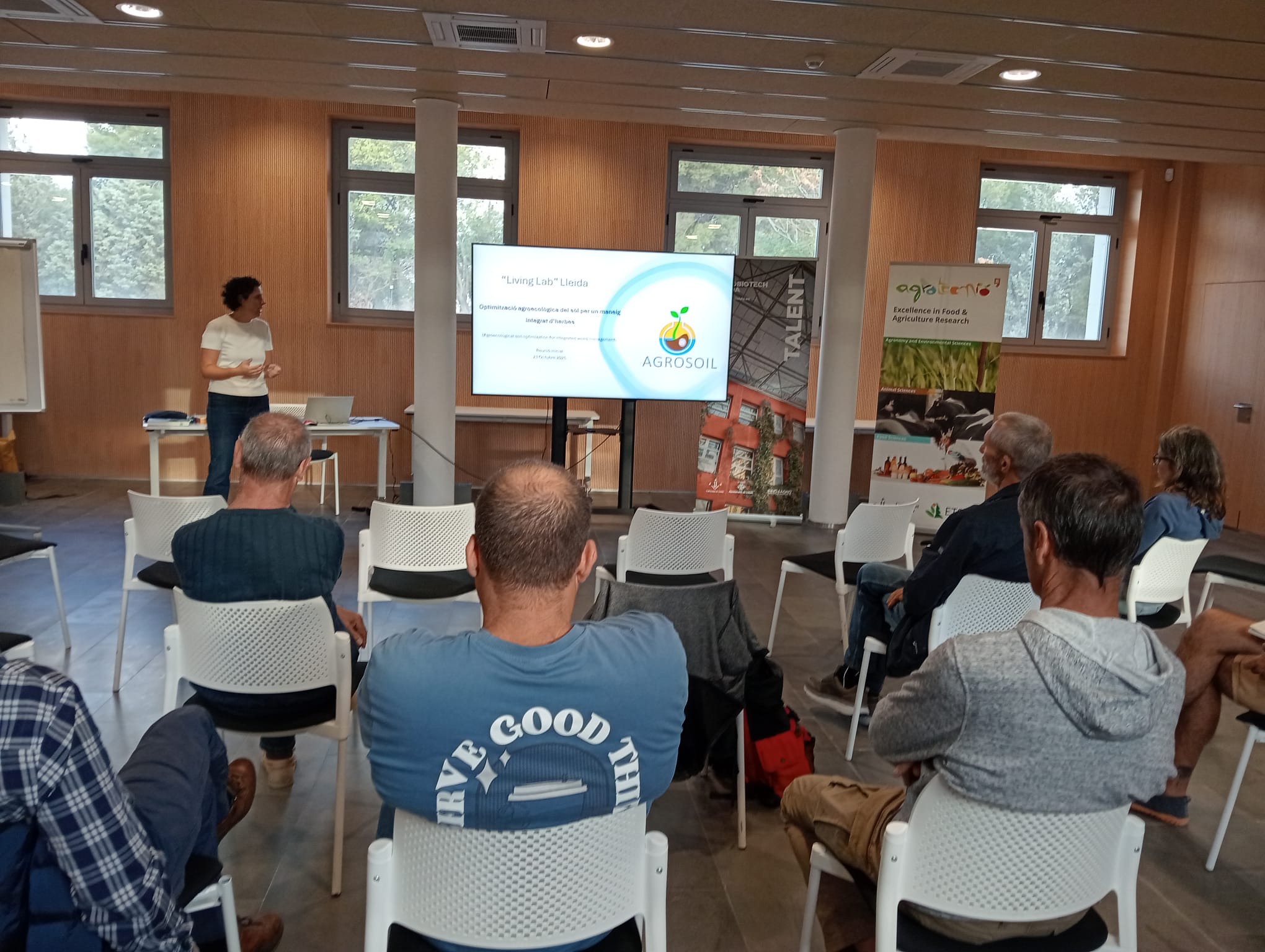
associació l’Era. On 23 October, the first meeting of the Lleida living lab took place at
Parc Agrobiotech Lleida, with representatives from these organisations and fourteen producers of cereals, legumes, vegetables and fruit from across the Lleida region.
As explained by Bàrbara Baraibar, researcher at Agrotecnio and UdL, who leads the project in Spain, “a group of around fifteen farmers have been selected and invited to participate because they are interested in testing agroecological weed management practices, and above all, they are curious about the relationships between weeds and soil microbiology.”
During the session, several weed management strategies were discussed, ranging from optimising the use of the star hoe to more innovative techniques such as the application of compost extracts or seed pelleting with beneficial microbiology. Following this first meeting, at least nine farmers will test these techniques on their own farms over the next two years.
The session was facilitated by experts in organic and regenerative agriculture Josep Ramon Saiz de la Maza and Gemma Comella.