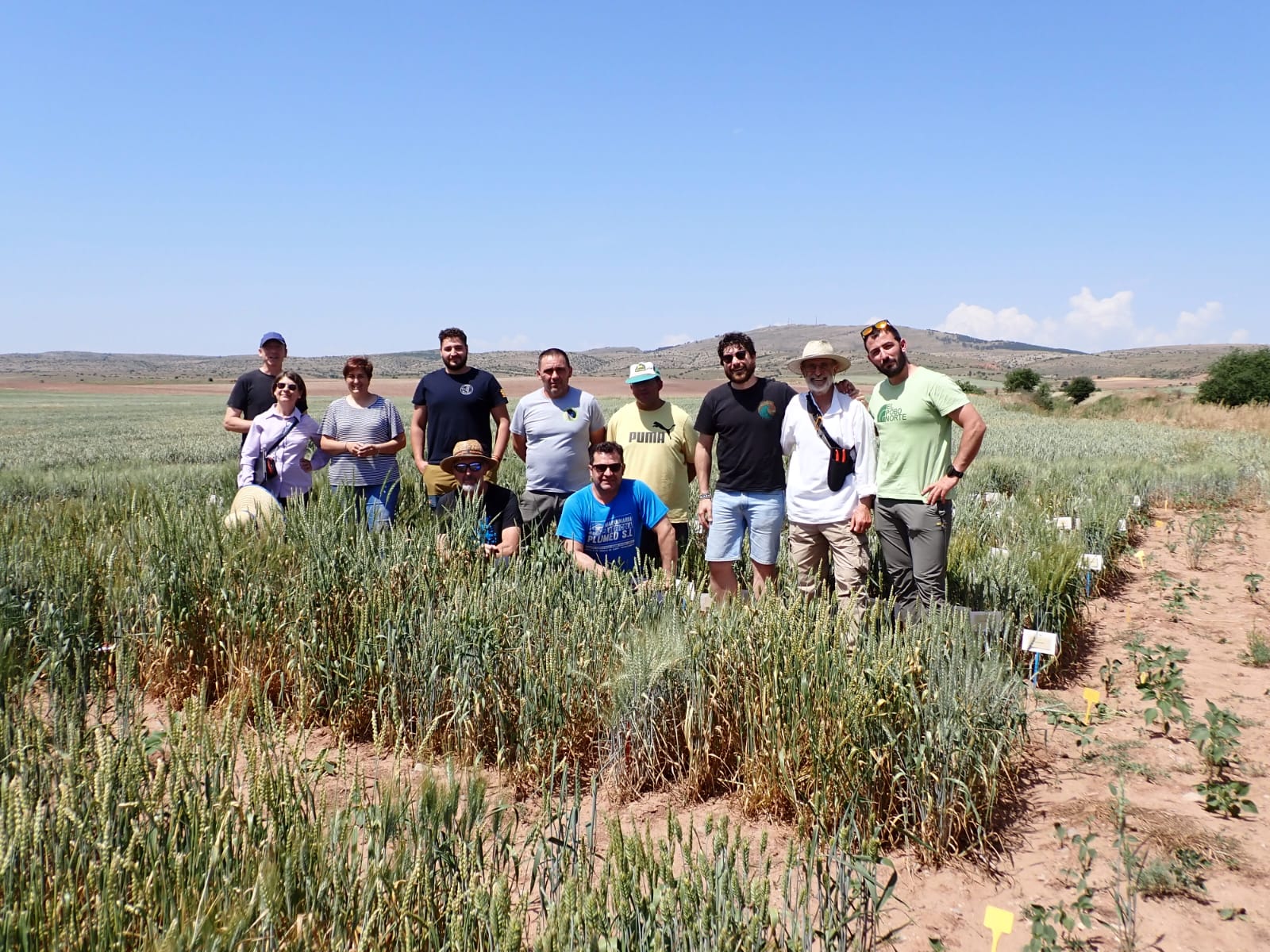
The town of El Pobo (Teruel) hosted the first field day dedicated to the study of stem rust (
Puccinia graminis), a fungal disease of great relevance for cereal crops, as part of the Wheat-4D-Future project, promoted and led by the research center Agrotecnio.
The activity was led by Professor Carlos Cantero Martínez, researcher at Agrotecnio – University of Lleida, together with Dr. Dolors Villegas, researcher at the Aula Dei Experimental Station – CSIC.
During the field day, participants were able to directly observe infected barberry leaves (
Berberis vulgaris subsp.
seroi), which allowed for an on-site explanation of the full biological cycle of stem rust, highlighting the role of barberry as an alternate host and key vector in the spread of the disease.
The core of the event was a visit to an experimental field trial designed under the Wheat-4D-Future project (funded by Agrotecnio), and the Mercedes project, co-funded by the MICIU/AEI and the European Union. In this trial, local technicians and farmers were able to observe active infections of both stem rust and yellow rust (
P. striiformis) in various wheat varieties.
The trial included:
- A collection of differential lines with resistance genes to various rusts.
- The 100 most widely cultivated bread wheat varieties in Spain.
Additionally, visits were made to surrounding fields to assess the incidence of rusts and weeds, fostering technical exchange and discussion about the current challenges faced by cereal farming in the region.
The event was held at the El Pobo community center, which hosted the introductory presentation and provided a closing snack for the participants.
About the projects:
- Wheat-4D-Future is fully funded by Agrotecnio and led by Professor Carlos Cantero Martínez.
- The Mercedes project (PID2023-149687OR-C32) is funded by the Spanish Ministry of Science, Innovation and Universities (MICIU), the State Research Agency (AEI) [10.13039/501100011033], and the European Union – Next Generation EU/PRTR.