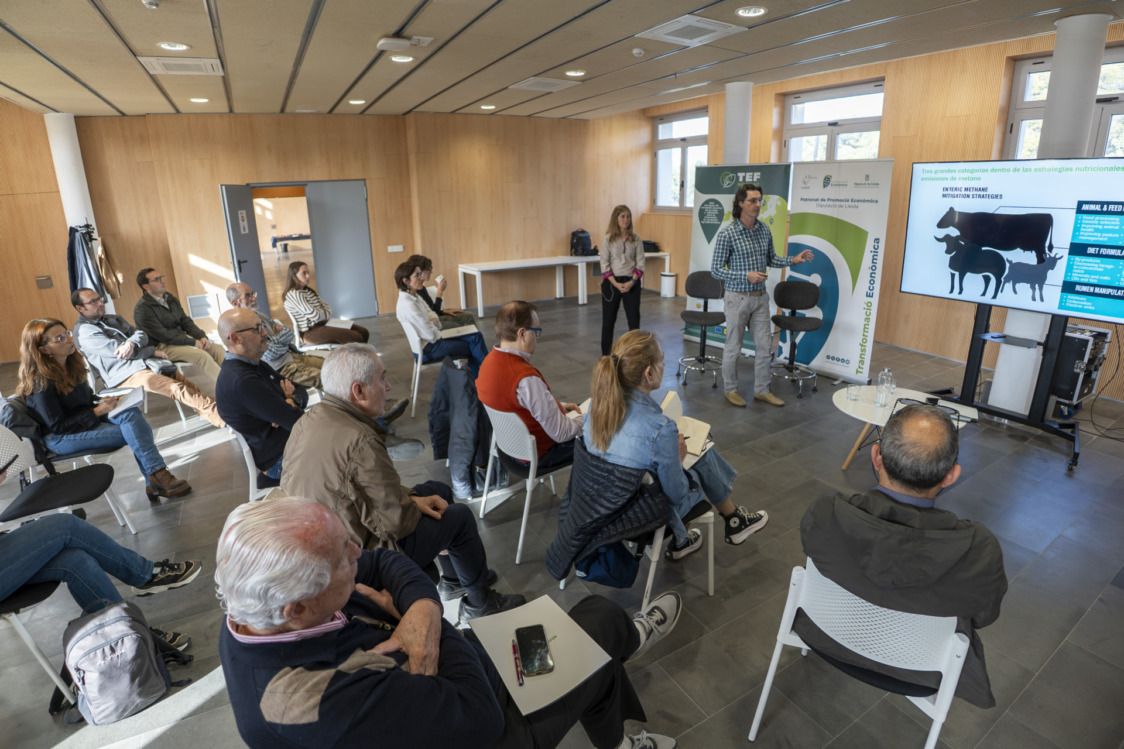
The April Breakfast4Inno analyzes how innovation in animal feeding can reduce ammonia, nitrogen and other emissions derived from livestock farming
Precision nutrition and feed additives are consolidating as two of the main tools to reduce the environmental impact of livestock farming, as was highlighted in the latest session of Breakfast4Inno. The innovation breakfast organized by Agrotecnio, the Agrobiotech Park of Lleida and the Provincial Council of Lleida, has analyzed how the formulation of diets and the use of new nutritional solutions can help reduce the impact of nitrogen and greenhouse gases associated with animal production.
The researchers Gabriel de la Fuente, from Agrotecnio and associate professor at the University of Lleida, and Estefanía Pérez-Calvo, researcher in animal nutrition and health at the company Dsm-firmenich, recalled that the global temperature has increased by approximately 1.5 ºC compared to the pre-industrial era, with various effects such as sea level rise, extreme weather events, loss of biodiversity or water stress in agricultural production. In this context, they recalled that the agri-food system is responsible for approximately one third of global greenhouse gas emissions, and that livestock farming represents 5% of these emissions.
Methane and ammonia: two key challenges in animal production
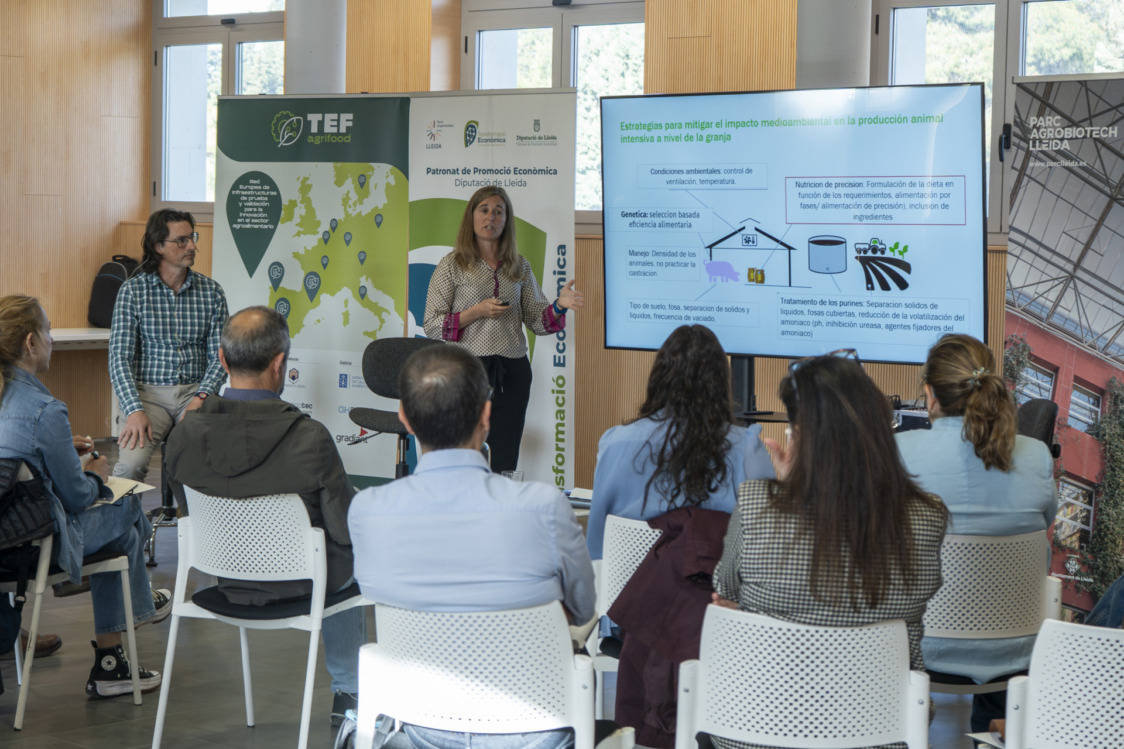
The experts focused their intervention on two of the main gases associated with livestock farming: methane, generated mainly by ruminants, and ammonia, mainly linked to the management of manure in pig and poultry production. To reduce these emissions, they presented various nutritional strategies.
In the case of methane, they explained that the origin of its release lies in the complex microbial ecosystem of the rumen, the main of the pre-stomachs of ruminants. This biological process, essential for digestion, entails as a side effect the emission of a gas with a high global warming potential.
Among the most advanced solutions to minimize it, they highlighted the use of specific inhibitors of methanogenesis such as 3-nitrooxypropanol, a compound that acts on a key enzyme in methane production. This additive, developed by the company dsm-firmenich under the trade name Bovaer, has more than 15 years of research and a hundred scientific publications. The experts stated that it has demonstrated its effectiveness under real farm conditions and that it is already used in dozens of countries, with accumulated emission reductions of more than 500,000 tonnes of CO₂ equivalent.
Pig production: reducing protein to decrease ammonia
In monogastric production such as pig farming, the main challenge is to reduce ammonia emissions derived from nitrogen excretion. The researchers explained that approximately 40% of the nitrogen ingested is retained by the animals, while the rest is excreted and can volatilize in the form of ammonia.
De la Fuente and Pérez-Calvo presented several strategies based on precision nutrition. One of them is the reduction of crude protein content in feed, complemented with essential amino acids, which allows reducing nitrogen excretion without compromising productive performance. Another strategy consists of incorporating fermentable fiber to modify fermentation and favor the reduction of the pH of the medium. The third line of action is the use of additives, such as organic acids. In this sense, they highlighted that benzoic acid has proven to be one of the best available techniques to reduce ammonia emissions, as it acidifies urine and limits the release of this gas into the atmosphere.
These strategies also provide additional benefits, such as the improvement of respiratory health of animals and working conditions on farms.
Environmental impact and economic benefits
The experts underlined the importance of scientifically evaluating the impact of these strategies through tools such as gas monitoring or life cycle analysis, which allows analyzing the environmental impact of a system throughout the entire production chain.
In pig production, the results show that the combination of protein reduction and the use of additives can reduce the carbon footprint, maintain system productivity when slurry is used as fertilizer and generate economic savings, estimated at around 4.66 euros per animal.
The speakers agreed that the farm is a key point for environmental mitigation, as it is where essential processes such as feeding, digestion and excretion are defined. “Precision nutrition emerges as a fundamental tool, based on adjusting the diet to the real needs of animals at each productive stage,” they highlighted.
They also remarked that the transition towards sustainable livestock farming requires a comprehensive approach that combines scientific innovation, technology, good management practices and the involvement of the entire value chain.
The event brought together experts from the agri-food sector and academic research. The session also included the participation of Joaquim Balcells, principal investigator of the Animal Nutrition and Environment group at Agrotecnio and full professor at the University of Lleida, who moderated the debate.
The next Breakfast for Inno will be held on May 14 and will focus on the control of the red spider mite in maize through the release of phytoseiids with drones.